Rainwater Collection

Rainwater Catchment in BucketsThe pacific northwest monsoon season is arriving in my neighborhood. I use the term “neighborhood” loosely, as I’m spending a few weeks living on a sailboat.

Life on the water finds even more uses for buckets than life on shore. On rainy days, just a few catch enough water to meet all my drinking and cooking needs. The water is delicious and clear, unlike our municipal source which has a faint yellow sediment tint this time of year.

The only filter I need is an old t-shirt tied over-top one of the buckets. Its main function is to filter out sand, which is ubiquitous on the boat. In my system, the two open buckets are poured manually into the filter bucket when I need water.

Rainwater Collection Filter

The rains here are aggressive enough that I don’t need a panel to collect enough water, but if I used a clean tarp to increase my collection surface I would have enough water to start a water bottling company! What would you pay for a bottle of fresh, pure, five gallon bucket water?
Strawberry Farm

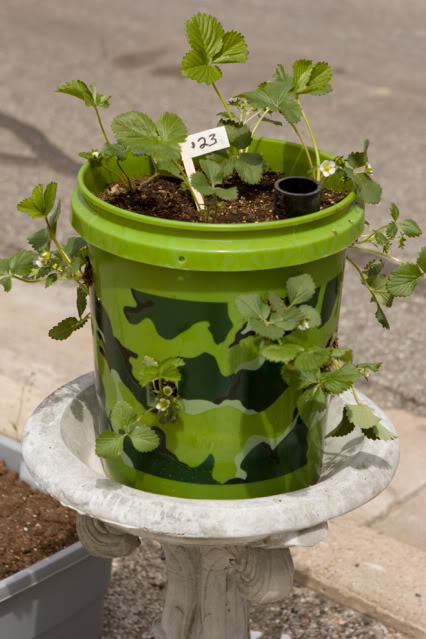
five gallon bucket strawberry planterBy growing strawberries (or other plants) vertically rather than horizontally, you are able to fit several times the number of plants into the same area footprint and the same volume of soil. As added benefits, your horizontal farm will be portable, hangble, mountable and stackable!

In the following video example, LDSPrepper plants 20 strawberries into a 1 square foot footprint, which would otherwise take 6 square feet or more of room. He uses several other techniques such as sub-irrigation and automatic watering, which we will cover in another post.

A standard 5 gallon bucket has room for 20 holes, supporting 20 strawberry plants. The holes are punched out with a 1 3/4″ hole saw. The lowest holes begin 3 1/2″ from the bottom of the bucket, and are spaced out every 6″. Watch the video for a more visual explanation of the correct hole dimensions and spacing.

Update:

Watch our new Gardening with 5 Gallon Buckets video for more ideas like this.

Wishing Well

Here’s an idea I discovered on BBC’s “Tightwads” documentary about extremely frugal people. This particular gentleman put a five gallon bucket at the end of his garden with a sign labelling it “Ye Olde Wishing Well.” On Friday, Saturday and Sunday, passers-by would throw money into the bucket, which he would collect on Monday.

If you want to watch the entire documentary, here is a link to a playlist of it on Youtube.

Indoor Planter

I have a banana tree which recently outgrew its small 2 gallon pot, so I repotted it into a 5 gallon bucket! Make sure to drill a few holes in the bottom for drainage. Here I am using an old drain board to catch the extra water – works perfectly!

Here’s someone who has made a 5 gallon bucket planter much prettier by wrapping with burlap material. I am not as concerned with aesthetics, but I have to admit it looks much more appealing than my version!

Soil Sifter

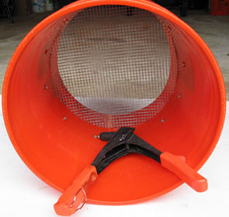
If you are comfortable with destroying the liquid retaining qualities of one of your buckets, you could use one to sift compost. Here is a series of pictures from one of the screeners I made. I used a 1/2″ drill bit to make these holes, but you could choose to go thicker or thinner, depending on what you are screening out.

To sift, just shake the bucket up and down or side-to-side using the handle. I find sifting dry soil or compost is easier than sifting wet, chunky blobs – but this is true no matter what type of soil sifter you are using.

The best part of this design is that you can sift directly into another 5 gallon bucket, with no mess!Update June 2012: A month after posting this, I found a fancier version that needs hardware cloth, but is probably a little bit quicker to make, and might sift better as well. Why not make both and see for yourself!

See the full article at skylighter.com.