Bike Panniers

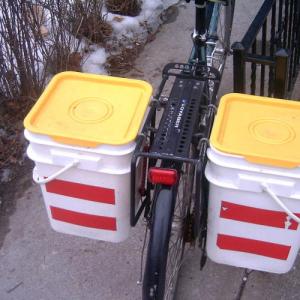
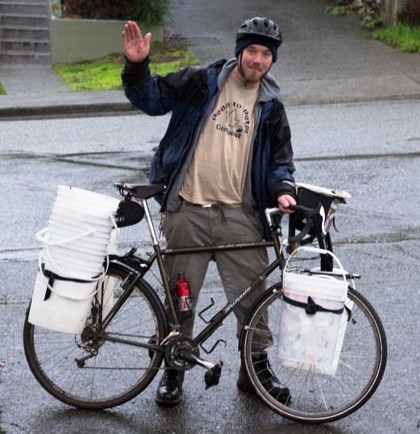
five gallon bike cargoI only learned the word “Pannier” recently, we always called them “bike bags” growing up. Square pails work best, but some of the guys that work for me use round pails with no negative effects.

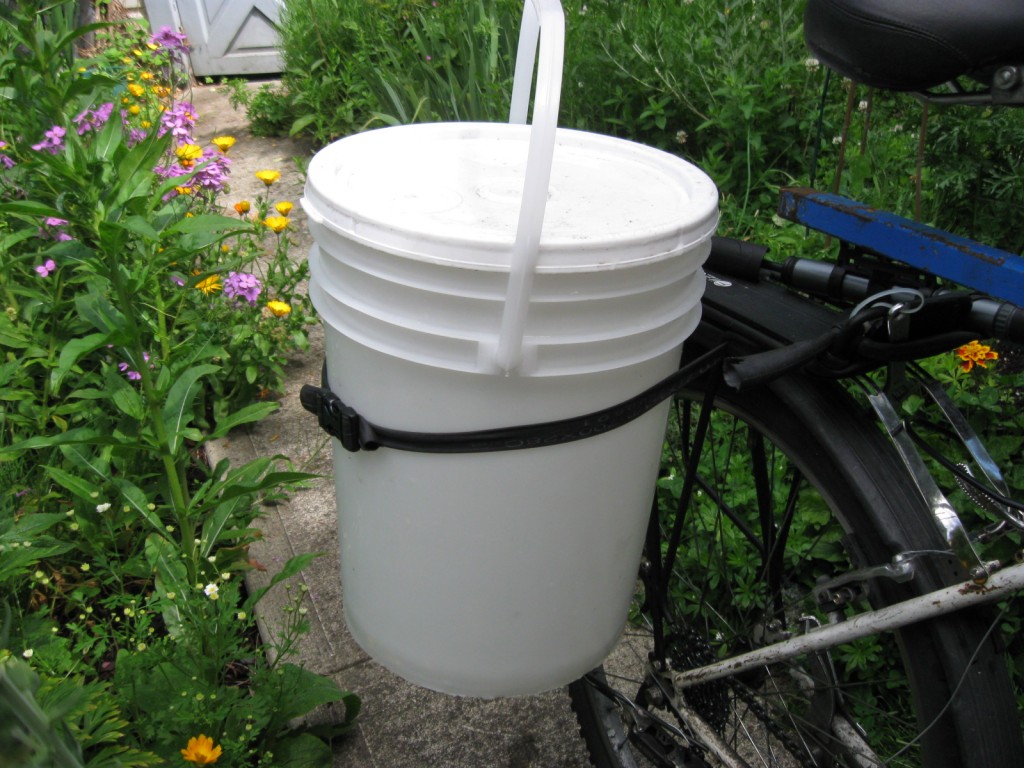
I have heard reports of people drilling into their buckets to add special metal attachments, but in my opinion there’s no need to make the bucket paniner so complicated, we just use cheap ratcheting straps like these ones which hold very strong and come off very easily. You will need a strong bike rack (sometimes called a “rat trap”) if you plan to carry heavy loads on your bucket cargo bike.

To double your carrying capacity, you can put a bucket on each handlebar, but make sure your handlebars are wide enough so the buckets do not interfere with your front wheel! This technique is not very safe, and should not be attempted over long distances.

When you park your bike, slip the bucket under the pedal for an instant kickstand!

bucket kickstand


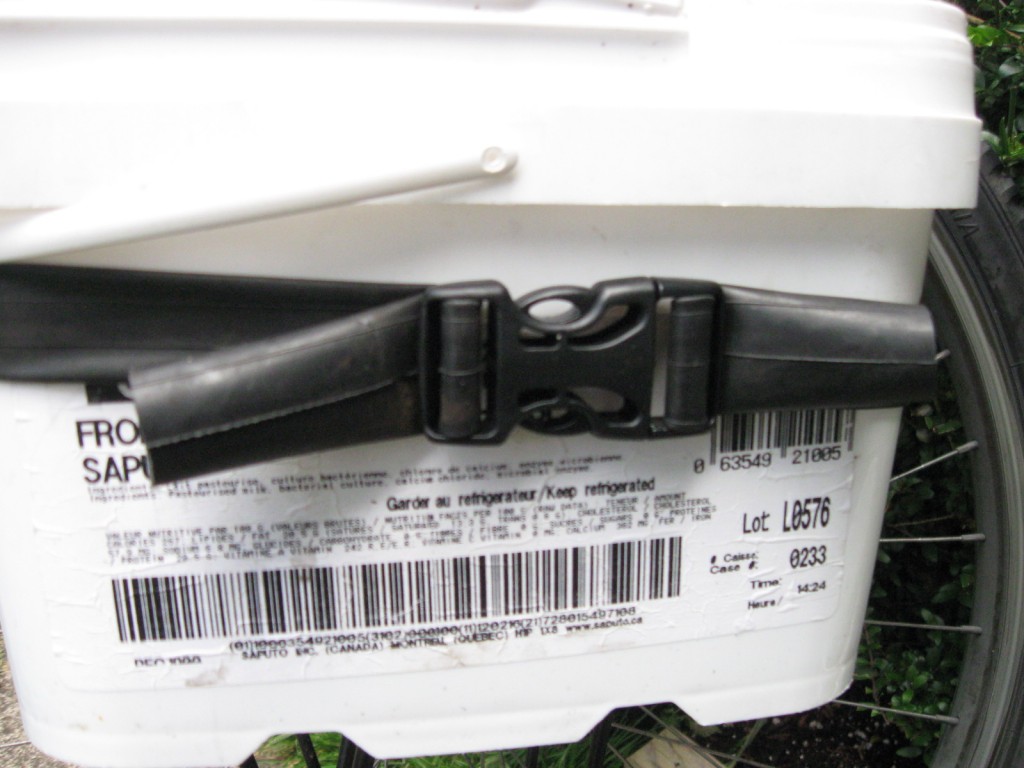
Update: I have engineered a special strap that works very well for carrying buckets around with a bicycle rack, pictured on the right. These straps cost 70 cents each to make, and use a bicycle tube connected with these plastic buckles. They are strong enough to securely fasten a full five gallon bucket (20-30 lbs.) onto a sturdy rack.
5 gallon bucket round bicycle pannier

Bicycle Straps Tutorial

finished-elastic-snap-strap-1024x195

For this project, you only need 2 ingredients:

  1. Plastic Buckles, male and female
  2. One or more used bicycle tubes

There are 2 widths of bicycle tubes I commonly see, 1″ and 1¾”. As far as I can tell, the former is for road bike tires while the latter is more commonly used for mountain bike tires.

For my straps, I’m using 1″ which makes a strap strong enough for most applications at home.

I get these straps by the dozen free from a nearby bike shop. They all have holes or tears in them, so they aren’t great for holding air anymore – but they work perfectly as straps, and they are extremely strong and durable.

bicycle-tubes-sizes-300x289

Plastic Buckles

I buy my plastic buckets from Mountain Equipment Co-op, which is the Canadian version of REI. I get them for about 70 cents per pair male and female. Make sure you choose the right size for you bicycle tube, size 1½” or 1¼” works perfect for my 1″ bicycle tubes. You can get them for about the same price on Amazon.

snap-clips-300x225

Making the Straps

I cut my bicycle tube into thirds to make 3 straps. You can make your straps as long or as short as you want of course. A strap may seem short, but these straps stretch very far. In the next 3 pictures, you can see the same strap holding 2 very different sized buckets securely to a bike.
bike-bucket-closeup-1024x768 five-gallon-pannier-1024x768 bike-bucket-768x1024


Graduated Cylinder

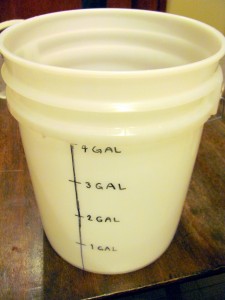
graduated cylinder five gallon bucket

It’s not terribly precise, but it’s easy to mark the side of a bucket with gallon or liter measurements. You can see the liquid level right through the bucket. Having volume levels on your pail is useful for brewing, soap making, soil mixing, or any other application that uses ingredients that need to be measured.

You could also mark a bucket off with inches or centimetres to gauge rainfall where you live, but I would use a lid with a hole drilled in it to prevent evaporation if you hope to measure rainfall over an extended period of time.

Water Filtration System

Five gallon buckets are already being used all over the third world in water filtration applications. A cheap, simple system that can be put together with local materials is the biosand filter. This type of filter has been shown to remove 90-99.9% of disease spreading contaminants and a large proportion of heavy metals from the water processed through the system.

Other third world water filtration systems such as chlorination and solar disinfection are more expensive and less effective.

bio sand filter


You can build your own five gallon bucket bio sand filtration system with a few five gallon buckets and some PVC pipe. Detailed instructions on a five gallon bucket based bio sand filtration unit are found on this ten page bucket filter pdf. For more information about the bio sand filtration process, read the BioSand Filter Wikipedia page or this extremely detailed 130 page biofiltration manual put out by the Center of Affordable Water and Sanitation Technology.

If you don’t mind spending a little bit more on an easier to build and better filtration system, you can build your own Berkey-style filter out of five gallon buckets, which will save you over 100$ over buying the full Berkey unit. (see price for the full berkey unit vs price for just the filter set.) With the ceramic add-on to the Berkey filter, you can even filter flouride out of your tap water.

Here’s a video from a guy who used the Berkey replacement filters mentioned above to make a home made water filter that works just as well as the expensive version!
Update: For an easy example of a water filter built using five gallon buckets, please see our guide here.

Wine or Cider Press

This is a reader submitted guest post from Shannon of Island Shire Farm.

Today we created a wine press.

I used some ideas from a couple of guys on the Internet, with a few of my own modifications.

five gallon bucket cider press

Here are the materials we used to make this unit:

  • 1 10′ long 2×10
  • 1 Home Depot bucket, very orange and unscratched
  • 2 yards of netting fabric
  • 1 8×8 fence post (14″ segment)
  • 1 car jack
  • Tray to catch juice

2x10 lumber cutting

First cut the 2×10 board into two 31″ pieces and two 18″ pieces. We cut the remainder into two rough hexagons that fit into the bottom of the Home Depot pail as platens, or squishing devices.

The greatest modification we did was in terms of what we did to the pail. Rather than the very large 1″ holes that Kimball Herrick used in his plastic buckets, or the spigot only that Kevin Kossowan used in his pail, we drilled a series of 1\2″ holes as close to the bottom as possible for the wine to pour out, and then a few more about 2″ and 6″ from the bottom, just for a little air flow.

Five gallon bucket with holes

The press itself is basically just a box with the four corners supported with little triangles for extra strength. At first we made the bottom triangles too big, and had to reduce the size so that the bucket could protrude a little toward the back. The power is supplied by a car jack which we ingeniously hung from the top with a single bolt. My jack’s base didn’t have any holes for bolts, so I inverted Kevin Kossowan’s design, and I think it’s better for it, since the base has a much larger area of pressing on the platen. In the photos, the press is sitting on top of a wooden chair to get it up off the ground.

wine making plastic bucket

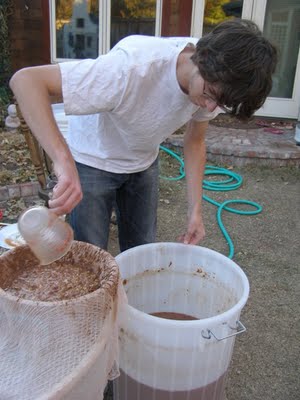
Here my helper loads the grape must, skins and all, from a 20 gallon food grade pail into the netting fabric, which is held in a stainless steel bucket. After this he pulls all four corners together and ties it all up into a nice little wet package with string. A lot of juice drains out this way, but the press gets the rest of it out quite nicely.

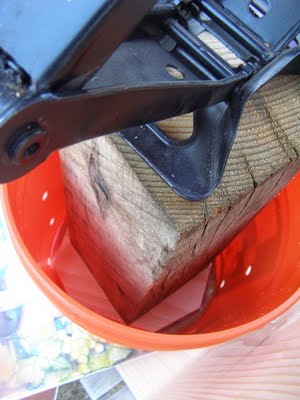
Here is a closeup shot of the platen being pushed down into the pail with our monster plunger. The car jack puts a good amount of force on the platen. The puck of skins and seeds comes out pretty dry.

five gallon bucket platen

Each one of these packages is called a “cheese.” We noticed that the cheese tended to spread out quite a bit in the first pressing, and since our platens don’t go all the way to the very edges, some of the cheese pooches out from under the platen inside the pail. So we took the much drier cheese out, jiggered the edges into the middle, and then twisted the whole package tighter and put it back into the press. We usually got more juice out that way.

For a while we pressed with just one package of must tied into cheesecloth. However, cheesecloth threads tend to move around, and on the third batch ours tore, so I had to go off to get some netting type fabric from Joann’s. Then we had enough fabric to do two at a time, so everything went a lot faster after that.

The tray is one that I bought from a thrift store, and fittingly has wine bottles on it. We drilled a hole along one edge and the liquid just drops down into a vessel. We will still be able to use the tray, and if anyone wonders what it is, we will say that it’s a WINE tray, can’t you see that?

From about 13 to 15 gallons of must, we have ended up with 10 gallons of liquid. Some of this will be lost in the various rackings we will do over time, to get rid of sediment.

If we ever get a big haul of apples, apparently I could also used this as a cider press, but that is for another day.

Editor’s Note: This design is a simplified version of the “Whizbang Cider Press” which is designed to be built yourself with some manufactured speciality parts. A photo essay is on the whizbang website, and detailed instructions are published in book form.

Bass Guitar

Everyone whose hit the bottom of a five gallon bucket has probably noticed that they make pretty good drums, due to their excellent resonanating qualities. With a little bit of creativity, you can use these qualities to your advantage in the creation of a functional musical instrument!

A variation on the “washtub bass,” the five gallon bucket bass uses common hardware to turn a five gallon bucket into a stringed musical instrument!

For full instructions on building your own, visit the Washtub Bass site.

And finally, here’s a guy who built an electric guitar out of a five gallon jerry can – he’s pretty talented with it too!