CSA box

CSA in a bucketI sell my buckets at cost to a number of farmers in the area, who mainly use them as harvest pails or feed storage. One farmer sends them back to me full of food as part of my CSA subscription.

CSA means “community supported agriculture,” whereby food eaters pay food producers for an entire growing season’s worth of food up front, allowing the farmer to pay for seed and equipment (not to mention rent!) without having to go to a bank for a loan. It also helps offload some of the financial risk from the farmer onto the food eater. This means your farmer will still be farming next year, even if their crop is damaged by pests or drought.

Many CSAs are delivered in rubbermaid totes, which can cost three or four times as much, and do not have a convenient carrying handle!

Sometimes my CSA box comes with a couple inches of water in the bottom, which keeps the leafy greens fresh and alive!

Sailboat

Christened the “Thunder Bucket,” this ultra-cheap sailing dinghy was cobbled together by professional boat builder Bill Tosh from used pallets and five gallon buckets. With a tarp for a sail and a 2×4 mast, the boat only cost $29.18 to make.

Instructions on building one of these aren’t published, but you can read the boat’s story  and see more pictures at pdracer.com.

Swamp Cooler

At the time of this post, July 5th 2012, a large part of the U.S.A. is ravaged by a 100F+ heat wave. Here’s a timely five gallon solution to this extreme weather:

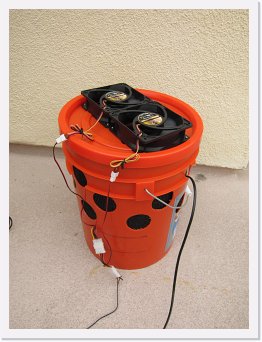
diy swamp coolerThis idea is sent in by a reader Geoff B. who has built one of these for his home. He says he is using a duct fan instead of a PC fan, but either works fine. Geoff says a single unit will not cool an entire room, but is effective for localized cooling around a single human being.

As you might already know, swamp cooler technology uses evaporation to create the moist cooling they are known for. Like the pot-in-pot refrigerator, this means the drier your climate, the better swamp coolers will work.

To make the swamp cooler, you will need the following Ingredients:

  • Five gallon bucket with lid
  • 2 computer fans
  • Irrigation tube
  • Shade cloth
  • Fountain pump
  • Air conduit
  • 12v DC power

If you think you’d like to take this project on, see the full step-by-step tutorial with lots of details and pictures on rengeekcentral.com.

See also a simpler design that will work in any climate: the 5 Gallon Bucket Air Conditioner

Refrigerator

Disclaimer: This experiment was not a success when using a plastic bucket. The principle is sound, but the impervious nature of plastic prevents enough evaporation to cool the system noticeably. If I can find a 5 gallon unglazed terracotta bucket, I will try the experiment again. 

The “pot-in-pot” refrigerator dates back at least 5000 years. The principle is simple, a small pot is nested inside a larger pot, and sand is packed into the gap. The sand is kept moist at all times. When the moisture evaporates through the top (and more importantly through the sides) it cools the inner pot to a surprisingly cool 59ºF (15ºC) – cool enough to keep meat for two weeks (source)

The evaporative cooling process is the same our bodies use to cool off when we sweat.

I built one of these pot refrigerators using one of my trusty five gallon buckets, but since the only contact with air is at the top, it did not evaporate enough to make any temperature difference. We tried to speed up the evaporation by putting our fridge beside a fire, so it would benefit from the heat and dry air, but it changed very little.

We live in a very wet climate, which is bad for evaporation. The drier your locale, the better this type of fridge will work.

Strawberry Farm

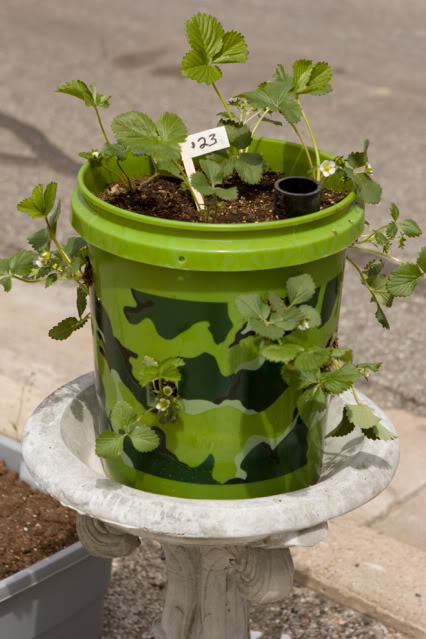
five gallon bucket strawberry planterBy growing strawberries (or other plants) vertically rather than horizontally, you are able to fit several times the number of plants into the same area footprint and the same volume of soil. As added benefits, your horizontal farm will be portable, hangble, mountable and stackable!

In the following video example, LDSPrepper plants 20 strawberries into a 1 square foot footprint, which would otherwise take 6 square feet or more of room. He uses several other techniques such as sub-irrigation and automatic watering, which we will cover in another post.

A standard 5 gallon bucket has room for 20 holes, supporting 20 strawberry plants. The holes are punched out with a 1 3/4″ hole saw. The lowest holes begin 3 1/2″ from the bottom of the bucket, and are spaced out every 6″. Watch the video for a more visual explanation of the correct hole dimensions and spacing.

Update:

Watch our new Gardening with 5 Gallon Buckets video for more ideas like this.